
 Tech With Tim
I Built The Same App with Every LLM
Summary
AI summaries can be incomplete or wrong. Verify anything important against the original video.
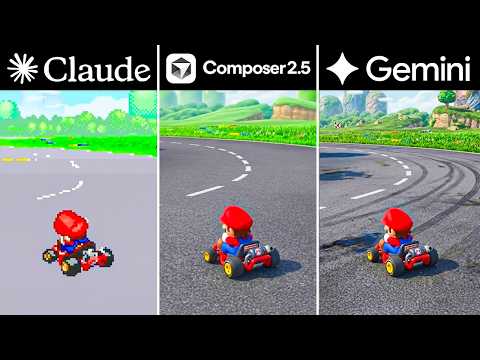
This video benchmarks six major LLMs by asking them to build the exact same top-down Mario Kart-style racing game using one specific prompt.
The content creator, Tim, tests the coding performance of six leading Large Language Models (Claude Opus 4.8, Cursor Composer 2.5, Kimi 2.5, Gemini 3.1 Pro, Grok Build 0.1, and OpenAI GPT-5.5) by having them build a functional top-down racing game. To ensure fairness, each model receives the same assets, a single prompt, and identical constraints. The experiment assesses models on code quality, speed, file structure, and overall usability of the resulting application. The results demonstrate a wide disparity in performance: while Claude Opus 4.8 produced a highly modular and fully functional game, other models struggled to integrate assets correctly or failed to produce playable code entirely. The video concludes with a comparative breakdown of build times, lines of code, and an overall leaderboard, highlighting that simpler models often prioritized speed at the cost of functionality, whereas larger models like Claude performed better on complex instruction sets.
Verdict
Claude Opus 4.8 is the most capable model for complex application generation, offering the best code structure and functionality, despite taking longer to build.
Pros
- Claude Opus 4.8 builds a fully modular, functional game engine.
- Gemini 3.1 Pro demonstrates extremely fast code generation speeds.
- OpenAI GPT-5.5 offers a good balance of usability and decent performance.
Cons
- Grok and Kimi struggled to provide playable, usable results in this complex task.
- Claude Opus 4.8 is significantly slower in generation time compared to competitors.
Specs
| Claude Opus 4.8 Build Time | 23:18 | |
| Gemini 3.1 Pro Build Time | 3:56 |
Compared to
-
Claude vs. Gemini
Claude excels in high-complexity tasks, while Gemini is superior for rapid prototyping.
Best for
Not for
Key Points
- 0:09 Tim defines the experiment: testing six major LLMs on building an identical Mario Kart-style game with the same assets, prompt, and constraints.
- 0:45 The experiment criteria for judging include code quality, completion time, lines of code, file structure, and zero-setup functionality.
- 1:54 Models are evaluated for handling a single initial prompt and one corrective follow-up prompt if the game is initially unplayable.
- 7:15 Testing concludes with a demonstration of each model's output; Claude Opus 4.8 succeeds with a complex, working engine while others present broken games.
- 10:47 Tim provides a secondary prompt for the models to fix bugs, significantly improving the playability of the generated applications.
- Final leaderboard summary: Claude Opus 4.8 secures the top spot with high-quality, fully modular code, followed by OpenAI GPT-5.5.
Worth watching if: You are a software developer evaluating which AI coding assistant or model is best for building complex features from a single prompt. It is also useful if you are interested in objective benchmarking methodologies for LLM performance.
Get every Tech With Tim video extracted like this
One daily email with structured extracts of every channel you follow. Free tier covers 15 videos a month.
Sign in with GoogleNo credit card. Free tier forever.