
 Veritasium
Total Solar Eclipse From Space
Summary
AI summaries can be incomplete or wrong. Verify anything important against the original video.
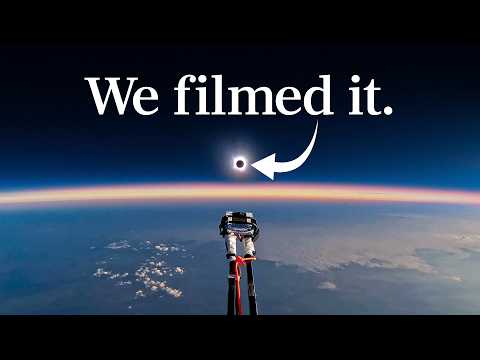
This video documents an attempt to film a total solar eclipse from space using high-altitude balloons and explains the complex mechanics of how and why solar eclipses occur.
In anticipation of a rare total solar eclipse in Spain, the Veritasium team partners with NASA's Borealis project to launch high-altitude balloons for a unique vantage point from near space. Beyond the documentary aspect of the launch, the video provides a clear, conceptual breakdown of the mechanics governing solar eclipses, including the roles of the Earth's and Moon's elliptical orbits, the Earth's axial tilt, and the phenomenon of 'eclipse seasons' determined by orbital nodes. It further explains the optics behind why solar eclipses appear as yellowish crescents to the naked eye but turn white during totality, and how pinhole-like gaps, such as those between tree leaves, create projected crescent shadows on the ground during a partial eclipse. Finally, the narrative explores the history of scientific discoveries made during eclipses, specifically the study of the solar corona and solar prominences through spectroscopy.
Concepts & takeaways
LockedKey Points
LockedWorth watching if: You are interested in the physics of celestial mechanics or want to see the unique logistics and perspective of capturing a solar eclipse from the stratosphere.
Sign in to unlock the full extract
Every claim, key point, and timestamp for this Veritasium video — plus a daily email of every channel you follow.
Sign in with GoogleNo credit card. Free tier forever.