
 Veritasium
The Technology that Made the Internet Possible
Summary
AI summaries can be incomplete or wrong. Verify anything important against the original video.
This video explores the invention and development of fiber optic cables, a technology that revolutionized telecommunications by allowing vast amounts of data to be transmitted over long distances using light. It details the scientific challenges of signal loss in glass and how researchers overcame them to create the backbone of the modern internet.
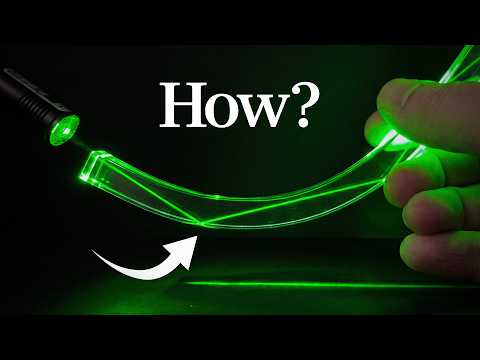
The video provides a detailed history of fiber optics, starting with the challenge of signal attenuation in glass that initially made the technology impractical for long-distance communication. It explains the core physics behind light transmission, including total internal reflection, and how the development of high-purity fused silica solved the problem of excessive signal loss caused by metallic impurities. The narrative highlights the critical contributions of Charles Kao and his team, who theorized and demonstrated that low-loss fiber optics were achievable, despite initial skepticism from the telecommunications industry. The video also covers the evolution of fiber manufacturing, from early experimental methods to advanced industrial techniques like plasma deposition and flame hydrolysis. Finally, it demonstrates how digital signals are encoded into light pulses, enabling the high-capacity, global data networks that power the modern internet.
Concepts & takeaways
LockedKey Points
LockedWorth watching if: You are interested in the engineering history and physics behind the fiber optic technology that forms the physical foundation of the global internet. It is also suitable for anyone curious about how researchers solve seemingly impossible technological challenges through iterative scientific inquiry.
Sign in to unlock the full extract
Every claim, key point, and timestamp for this Veritasium video — plus a daily email of every channel you follow.
Sign in with GoogleNo credit card. Free tier forever.