
 AI Jason
How Boris prompt 1000+ agents overnight...
Summary
AI summaries can be incomplete or wrong. Verify anything important against the original video.
This tutorial explores three distinct concepts referred to as 'graph engineering' in the context of AI agent development: control graphs, knowledge graphs, and graph-of-loops. It provides a practical guide on leveraging modern orchestration tools to move beyond simple prompts and build robust, autonomous agent systems.
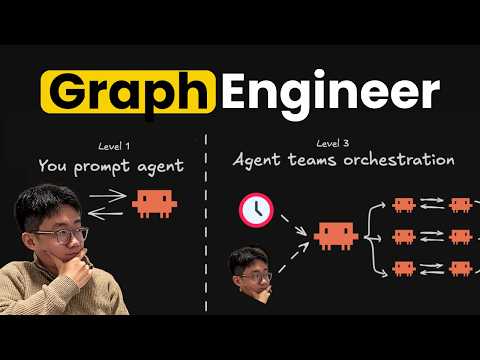
The video demystifies the popular, often confusing, term 'graph engineering' by categorizing the different concepts it currently encompasses in the AI community. The host defines three distinct interpretations: control graphs, which represent structured standard operating procedures (SOPs) for reliable task execution; knowledge graphs, used for organizing and retrieving entity relationships; and graphs-of-loops, a paradigm for running interconnected, self-improving task loops. The central thesis is that shifting from human-prompted agents to systems that trigger and manage themselves is essential for scalability. Through practical code examples, the creator demonstrates how to implement these patterns using tools like 'dynamic-workflow' and LLM-as-graph approaches. He emphasizes that building reliability requires defining strict node inputs/outputs, state tracking, and appropriate automated verifiers, ultimately enabling complex agent orchestrations that can manage thousands of tasks.
Steps to follow
Locked-
1
-
2
-
3
-
4
-
5
Key Points
LockedWorth watching if: You are building autonomous AI agent systems and need to move beyond simple linear chains to more complex, self-managing, and reliable orchestrations. This is essential viewing if you want to understand how to structure and implement robust multi-agent systems.
Sign in to unlock the full extract
Every claim, key point, and timestamp for this AI Jason video — plus a daily email of every channel you follow.
Sign in with GoogleNo credit card. Free tier forever.