
 Veritasium
How does light 'know' the shortest path?
Summary
AI summaries can be incomplete or wrong. Verify anything important against the original video.
This video explores Fermat's principle of least time, explaining that light doesn't simply travel in a straight line but takes the path that requires the least time, which is analogous to a human trying to save a drowning friend at the beach.
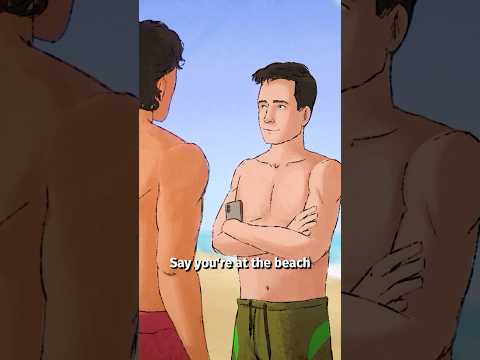
The video begins by posing a thought experiment: if you're at point A on a beach and need to reach a friend struggling in the water at point B, which path should you take to minimize travel time? It highlights that running on the beach is faster than swimming. A straight line path might be shortest in distance, but it involves more swimming. Running down the beach to minimize swimming distance increases the overall distance. The optimal path lies somewhere in between, dependent on the relative speeds of running and swimming. This scenario is then linked to Snell's law, which governs how light bends when passing between different mediums. The video explains that light, too, takes the path of least time, a principle famously articulated by Fermat. Instead of simply refracting at an interface, light is presented as exploring all possible paths simultaneously, and the path we observe is the one that takes the least time. This principle is described as one of the greatest illusions in physics, as it implies a form of 'knowledge' or 'intention' in light's behavior.
Concepts & takeaways
LockedKey Points
LockedWorth watching if: You're interested in the fundamental principles of physics, particularly how light travels and why it bends. This video offers an intuitive explanation of Fermat's principle and its connection to optics.
Sign in to unlock the full extract
Every claim, key point, and timestamp for this Veritasium video — plus a daily email of every channel you follow.
Sign in with GoogleNo credit card. Free tier forever.